Quality Documents: Long Live Clarity!
In a Quality approach, we often talk about "documents", but this word hides two very different realities: system documents (or associated documents) and records.
System documents: what sets the framework
System documents describe how things should be done. These include procedures, work instructions, policies, standards, templates, etc. They set the framework, structure practices, and provide a common method. Above all, they prevent everyone from reinventing the wheel and bring consistency to the organisation's practices.
These are the documents that Uscope allows you to centralise, structure, comment on, version and link to processes and roles.
Records: what proves
Records, on the other hand, are proof that things have been done. An attendance sheet, an audit report, a validated order: these are traces, results. They are not modified, they are preserved. Uscope does not manage this part, but the processes to which documents are attached can, of course, provide for the production of these records.
Why version system documents?
Because they evolve. Because we learn, we improve, we adjust. But above all because it is essential to know who modified what, when, and why. Uscope allows you to keep all versions of a document, with a clear history and access to comments. No more wasting time looking for "the latest validated version" in the meanders of the shared server.
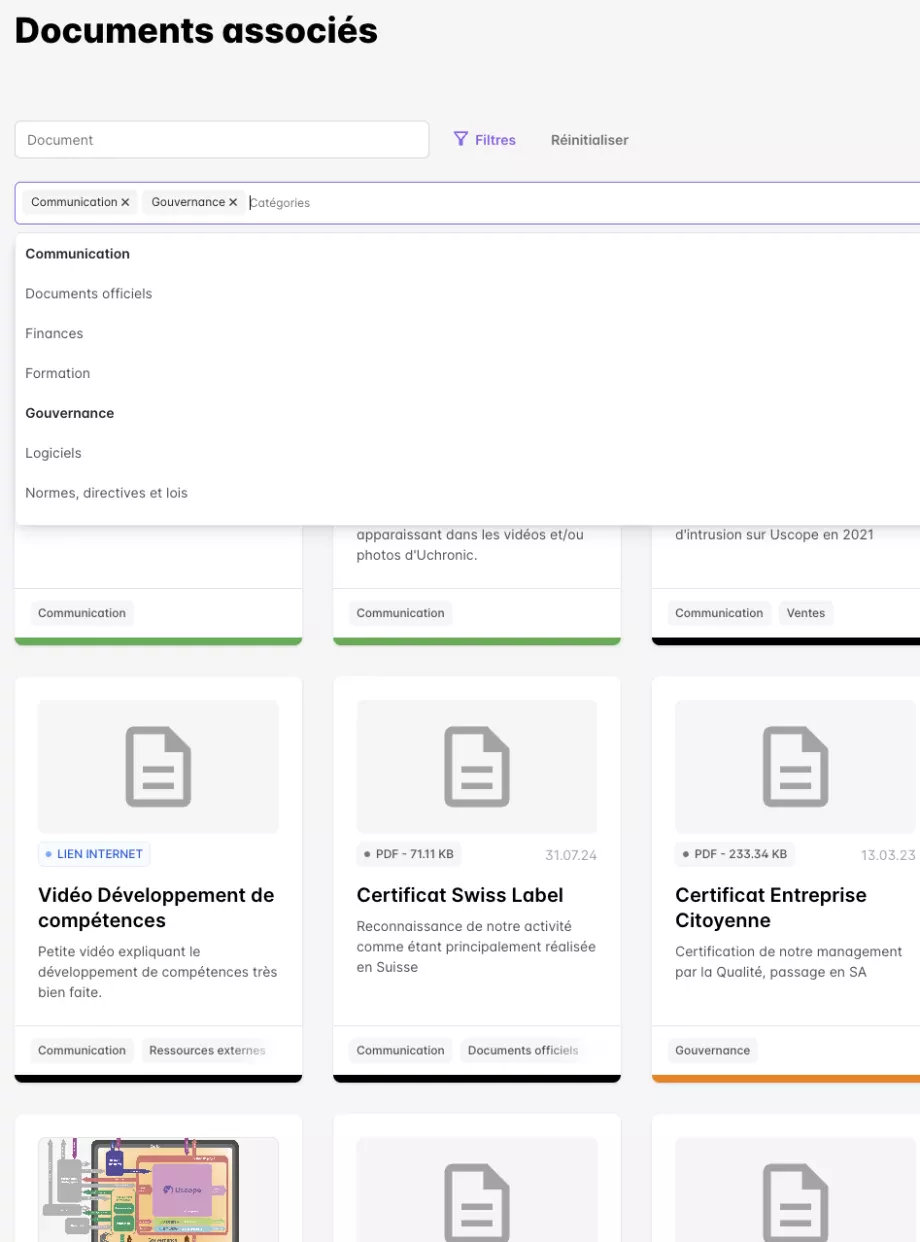
Simple access, not a treasure hunt
Document management is not archiving. A Quality document must be available where it is useful: at the right time, for the right person. Uscope allows you to navigate by process, by role, or by standard. The idea is that everyone accesses the documents that concern them directly, without getting lost in an obscure tree structure or an esoteric Excel spreadsheet.
And the document matrix in all this?
The document matrix is an essential tool for managing the entire document system. It provides an overview of system documents: their type, their scope, their status (draft, in progress, validated), their update date, their owner, etc. It is a living snapshot of the state of the document system. In Uscope, this matrix is generated automatically from the metadata of each document, which avoids time-consuming and unreliable manual tracking.
Everything is connected
A good document system is alive. Each document is linked to a process. Each process has roles. Each role has people. This interconnection is what Uscope makes visible and actionable. Document management then ceases to be an administrative obligation and becomes a lever for clarity, coherence and collaboration.
In summary
Document management is not just about paperwork or ISO compliance. It is a powerful lever for structuring practices, sharing knowledge, and gaining collective efficiency. Provided you have the right tools... and the right logic.
With Uscope, you don't manage files. You structure a system. You link documents to what they truly serve: processes, roles, skills. And, little by little, a clearer, more coherent, more vibrant organisation emerges.
Not bad for documents, right?