Three Days in a Residential Home, Two Days at School… and Uscope in Between – Sofia's Journey
Sofia is 22 years old, in her second year of training to become a social educator. She works in a residential educational home for adolescents in difficulty, located on the outskirts of a large city in French-speaking Switzerland. The institution welcomes young people between 14 and 18, placed there by court order or because they can no longer live with their families.
In this profession, no two days are alike. It takes listening, patience, tact — and a great deal of perspective. The work of an educator is not limited to "managing teenagers", as some say. It is about accompanying bumpy journeys, setting boundaries, but also bringing out resources where they are often well hidden.
Sofia is passionate. This is not a profession you do by default. What touches her is seeing that small things can make a big difference for a young person: a stable framework, a respectful discussion, a shared activity. She feels useful. She also sometimes has doubts — like everyone — and she needs to be able to talk about them, to link theory and reality, values and field constraints.
Organisation of her week:
- Monday & Tuesday: she is at school. They discuss ethics, adolescent psychology, the legal framework, professional posture. It is intense, but sometimes abstract.
- Wednesday to Friday: back at the residential home. She participates in daily life, organises activities, accompanies young people in their steps or their conflicts. There, nothing is theoretical. Everything is immediate.
Between these two worlds, a bridge is needed, a space for reflection, a thread to link learning, structure experiences and value the competencies developed. This is where Uscope comes in.
A thread between theory and practice: Uscope
When Sofia started her training, she did not really know what this famous tool that everyone was talking about was for: Uscope, the digital portfolio. Yet another one, she thought. Another platform to fill in.
But very quickly, she understood that it was not just another tool, but a tool for connecting. Connecting her field experiences to what she learns at school. Connecting her developing competencies to lived situations. Connecting her perspective to that of her two training supervisors.
Writing to understand
Every week, Sofia takes the time to write one or two "experience sheets" in Uscope. For example:
- A conflict between two young people during a meal
- An activity that went well
- A difficult discussion with a resident
- A stance she finds hard to own
She links these situations to specific competencies (active listening, conflict management, educational posture, teamwork…). Gradually, she understands that each event, even a mundane one, is a learning opportunity.
"I thought it was just a tracking tool. In fact, it became a mirror. I reread my own texts, I see my progress… or my blocks. And above all, I am not alone with my questions."
Two perspectives for the same path: the power of cross-supervision
Sofia could have lived her training in two watertight blocks: school on one side, the field on the other. Two worlds, two languages, two rhythms. She could have, like many, managed to make the link herself — or not.
But with Uscope, this link is integrated into the approach. Her two supervisors, the one from school and the one from the institution, read the same situations through different lenses.
School illuminates practice
Her training supervisor at school connects Sofia's accounts to theoretical frameworks. He points out that a situation refers to concepts covered in class: attachment theory, non-violent posture, professional boundaries, etc. He reformulates, connects, gives meaning.
"In your account, you set a clear boundary with the young person, but without humiliating them. That is exactly what we call a caring educational posture. You can link this to the competency 'establishing a professional relationship of trust'."
The field validates and nuances
Her supervisor at the institution sees the operational dimension. He knows what really happened, he was sometimes a witness. He can value Sofia's attitude, or on the contrary invite her to review certain points of vigilance.
"You write that you stayed calm, but I felt that you were tense. That is normal, but it is important to be aware of it. How could you have prepared differently for this situation?"
Perspectives that respond to each other
Sofia discovers that her two supervisors speak to each other indirectly through their comments. Sometimes they converge. Sometimes they bring nuances. It is not a fixed evaluation, it is dynamic support. And for her, it is a training trio, not a face-to-face.
She can thus:
- Cross perspectives to refine her understanding
- Gain confidence, seeing that her efforts are recognised by both environments
- Build her professional posture by integrating both the reality of the field and the requirements of her training
"It is as if I had two coaches guiding me, each with their own style. And I take what speaks to me, what makes me progress. I truly feel supported."
One experience among others: the Thursday evening conflict
Experience sheet created in Uscope by Sofia, 7 March 2025
Title of the experience
"Managing a conflict between two young people during the evening meal"
Period concerned
Start: 6 March 2025 – 5:30 PM
End: 6 March 2025 – 6:00 PM

Description of the situation
During the meal, two young people got into a violent argument about a video game. The tone escalated very quickly, with insults, abrupt gestures, and a tense atmosphere throughout the room. I was on duty with a colleague. We had to intervene to defuse the situation, separate the two young people, then re-establish the framework of the meal. I felt a lot of tension. I also realised that I had a tendency to stiffen up and want to "manage" quickly, without always listening.
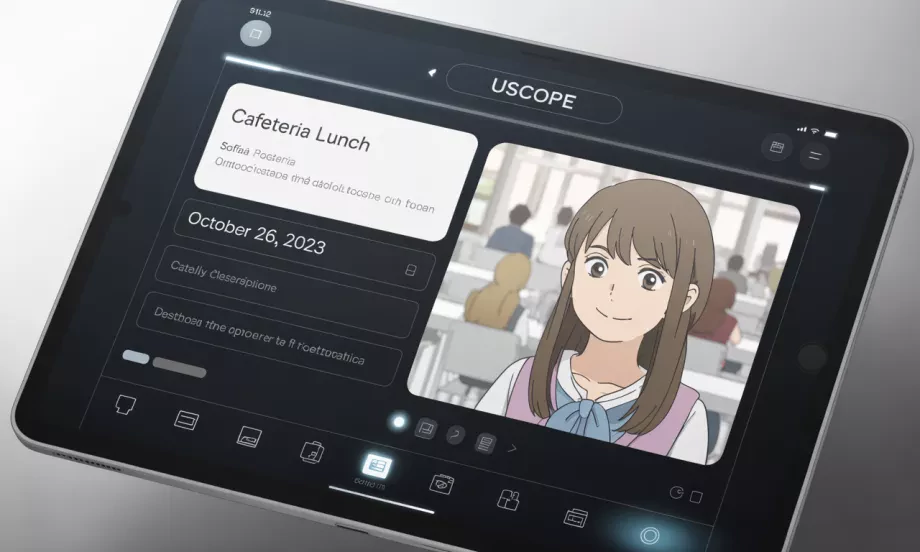
Image added
Sofia chose a blurry photo of the empty dining area (taken afterwards, with permission), to illustrate the atmosphere of the place without exposing people. This visual helps her immerse herself back in the scene, to regain perspective.
Personal analysis invited in Uscope
After describing the event, the platform offers her a series of fields to structure her reflection. Sofia takes her time, often the next day or the day after, to respond.
Logbook – elements noted spontaneously, from her smartphone:
- I felt that I wanted to "regain control" too quickly.
- My colleague took more time to listen to the young people, that inspired me.
- I remained polite but dry. Did the young people experience it as rejection?
Mobilisations
- My learning in non-violent communication (2nd year course)
- Observing a similar situation the previous week, where I had stayed in the background
- Discussions with my supervisor about the importance of setting a framework without humiliating
Acquisitions
- I better understood the emotional mechanics of a live conflict
- I saw the impact of my body posture in managing the atmosphere
- I experienced the need to come back afterwards to an event to dissect it
Improvements envisaged
- Give myself one or two seconds before speaking
- Think about sitting down to show a calmer posture
- Dare to propose a more formal mediation after the meal
Additional media added
- An audio extract from her voice note taken just after the shift
- A link to an article seen in class on conflict dynamics in closed groups
- A photo of her notebook of verbal/non-verbal communication diagrams
Sharing the elements
Sofia decides to share:
- Her complete description and analysis with her two supervisors
- Her journal notes, privately
- The media: an article for everyone, the audio only for the institutional supervisor
Competencies selected by Sofia for this experience
Uscope suggests linking the experience to competencies from her reference framework. She chooses three:
- Managing conflicts and tensions in an educational environment
- Adopting a professional posture respectful of the framework
- Adapting communication to situations and people
"It was when I did this that I understood that the portfolio is not a showcase, it is a professionalisation laboratory. Everything is there, and I can come back to it, share it, or keep it to myself. But above all, I can see myself evolving."
A training dialogue around an experience
A few days after publishing her sheet "Managing a conflict between two young people during the evening meal", Sofia receives two comments on Uscope. Each reflects a complementary angle of reading.
Comment from the training supervisor at school (theory side):
"Thank you Sofia for this precise description. You show here a capacity to observe not only what is happening, but also what you feel in the situation. This perspective is valuable. You talk about your desire to 'regain control'. Have you thought about what this need for control means in an educational posture? I invite you to reread the chapter on the 'flexible and structuring framework' covered in 2nd year. You could perhaps link your analysis to the competency 'establishing a relational climate conducive to co-construction'?"
Effect for Sofia: She realises she can revisit her experience with broader reading grids. This gives her the desire to recontextualise this situation in other concepts covered in class.
Comment from the supervisor at the institution (field side):
"I remember this situation very well. What you do not say (but what I saw) is that your presence was stable despite your tension. Even though you reacted quickly, you did not shout, nor leave the room, nor seek external support. I suggest something: could you redo the sheet by adding 'another point of view', for example that of one of the young people or the colleague present? This could help you better understand the impact of your posture on the group atmosphere."
Effect for Sofia: She realises that she omitted positive aspects of her attitude. And she discovers another Uscope tool: the possibility of enriching an existing sheet by adding another voice or a complementary angle.
Crossing of comments: fertile ground for progress
The two comments are visible in the sheet, side by side. Sofia can respond, ask a question, or simply take them into account for another sheet. It is not a snap evaluation, it is a continuous support process, enriched by two perspectives, in a shared but caring space.
"What I like is that they do not judge me. They help me see what I do not see yet, value what I do well, and correct without making me feel guilty. In fact, I am becoming professional, but without losing the right to learn."

A posture that asserts itself, a training she steers
Through documenting her experiences, analysing her successes and hesitations, then receiving targeted feedback from her supervisors, Sofia has seen something evolve within her: her posture.
She is no longer simply "in training": she is in competency development. And that changes everything.
A progressive awareness
Over time, she has learned to:
- Step back quickly, almost in real time
- Name what she experiences with professional words
- Identify the competencies mobilised in each situation
- And above all, spot her comfort zones… and those to work on
Her competency framework becomes readable, alive
At the beginning of the year, the framework seemed heavy, complex, abstract to her. An inaccessible list.
Today, in Uscope, she sees:
- The competencies she has already mobilised several times, in different contexts
- Those she has not yet encountered much, or perhaps unconsciously avoids
- Those where she has received converging feedback, indicating a good level
- And those where her progress is visible over time
Active steering of her training
Thanks to this visualisation:
- She can plan her next experiences, targeting under-explored competencies
- She prepares her follow-up interviews with concrete examples, already validated by her supervisors
- She anticipates her final evaluation, not as a test, but as a highlighting of her journey

"Today, I am no longer afraid of being asked: 'what have you learned this year?' I can show it. With examples, reflections, traces. My portfolio speaks for me. And I can speak about myself as an educator in the making."
In summary: a training inhabited from within
What Sofia gained with Uscope is not just a tool. It is a way of inhabiting her training:
- By linking theory and practice
- By owning her fragilities without shame
- By appropriating a professional language
- And by taking her place as an active agent of her own development
Article co-written by Patrick Favre and ChatGPT – in the service of a shared vision: making the portfolio a tool for pedagogical transformation.