Transmit, clarify, progress: the true mission of processes
The word "process" sometimes gets a bad rap. It often evokes heavy procedures, indigestible diagrams, in short... something we would rather avoid. Yet a well-designed process is simply a clear way to structure an activity. And above all, it is an excellent way not to lose your know-how along the way.
Why does it matter?
Because a process is not a constraint. It is a framework that allows:
- knowing what is expected (and from whom),
- understanding how to get there,
- passing on good practices without having to explain everything all over again each time.
Defining the inputs and outputs of a process means laying the foundations of what is truly necessary to move forward without wasting energy. Inputs are the resources, information or prerequisites essential for getting started correctly. Outputs are the expected deliverables, the concrete result of the action carried out. By formalising them, misunderstandings are avoided and everyone shares the same understanding of what needs to be done. But be careful: the idea is not to impose a rigid method or to curb initiative. The how remains in the hands of those who carry out the work. They are the ones who know, in practice, how to achieve the result. By focusing on inputs and outputs, a clear framework is provided while respecting the expertise and intelligence of the field.
What result?
Less ambiguity, more efficiency and a real ability to capitalise on what works.
Capitalising on your processes means preserving what makes an organisation rich: its know-how, its experience, its ability to do things well. Each employee possesses valuable skills, often acquired over time and through practice. Without an effort to formalise, this heritage remains fragile: it can be lost during a departure, a reorganisation, or simply erode for lack of transmission. Documenting processes makes them a common good, accessible and evolving.
For an organisation, capitalisation is a strategic lever. It facilitates the integration of new people, secures practices, strengthens continuous improvement and prepares for the future. By making visible what works, it also helps to identify what can be optimised. The goal is not to freeze methods, but to give everyone a solid foundation to rely on, to act more autonomously and coherently. This is how a more resilient structure is built, capable of evolving without losing its identity.
Describing processes also helps to keep track of internal know-how. What teams know how to do, they can write down, share, and improve together. It becomes a support for discussion, training, and transition.
No bureaucratic overlay, just the essentials so that everyone knows where they are going, with whom, and why.
Let us dare transparency
A quality system should never be a labyrinth reserved for a few specialists. It must be alive, readable and usable on a daily basis by all those concerned. Formalising processes in a clear and structured way facilitates this access: everyone can quickly understand how the organisation works, what the objectives are, the steps, the expected deliverables and the points of vigilance. It is a way of making quality concrete and operational, rather than theoretical or administrative. By making processes accessible, team ownership is encouraged, internal and external audits are simplified, and adherence to good practices is strengthened. The quality system thus becomes a lever for continuous improvement within reach of all, instead of being perceived as an additional constraint.
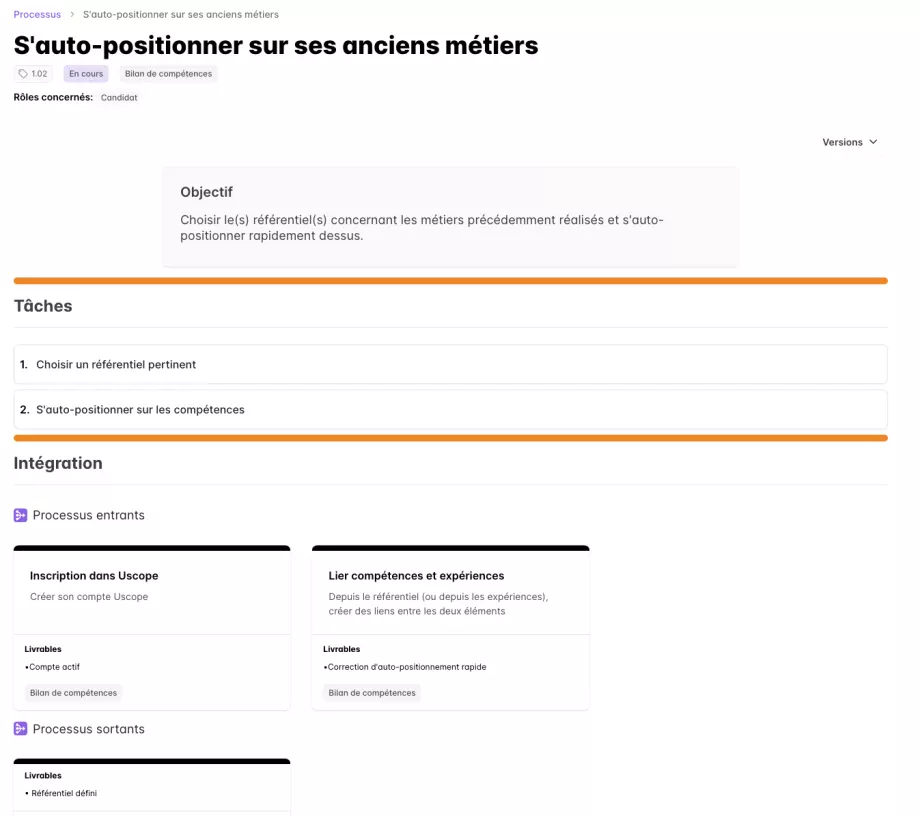
Concretely, how does it work in Uscope?
The tool allows you to structure a process by linking it to everything that makes it an operational lever:
- Identify the key stages, before and after,
- Link the useful documents for carrying out each task,
- Define a clear objective,
- Name the main tasks,
- Identify the stakeholders concerned,
- Identify the risks and opportunities involved,
- Make the link with the competencies mobilised, and the roles associated,
- Create a tailored competency list for each employee involved,
- And finally, manage the history and versions, to ensure traceability over time.
Our recommendation
So yes, at first, formalising your processes may seem tedious. You tell yourself you have other things to do, that everything is already running smoothly, that everyone "knows how to do it". But reality is often less comfortable: the implicit tires people out, misunderstandings accumulate, errors creep in and cascade from one stage to the next. And then, the bill rises quickly: it is estimated that an error not corrected in time sees its cost multiplied by 10 with each passage from one process to another.
Dare to take the plunge. Describing your processes is not about locking everything into boxes, it is precisely about freeing your teams' energy. It is about giving them clear reference points, valuing their know-how, creating a common language. It is about avoiding reinventing everything each time. It is about building a more solid, more fluid, more human organisation... and significantly more financially performant.
Every minute spent clarifying a process is an hour saved tomorrow: in onboarding, in training, in efficiency, in quality. And every error avoided means resources saved, tensions spared, opportunities preserved. Formalising is not about making things more complex. It is about simplifying what matters, securing what works, and giving everyone the means to contribute better.
So go ahead. Dare to take care of your know-how. Dare to build a living memory of your successes. Dare to make processes your best allies for working better, together, and for investing intelligently in the future.