Why the digital portfolio has become indispensable in 2026
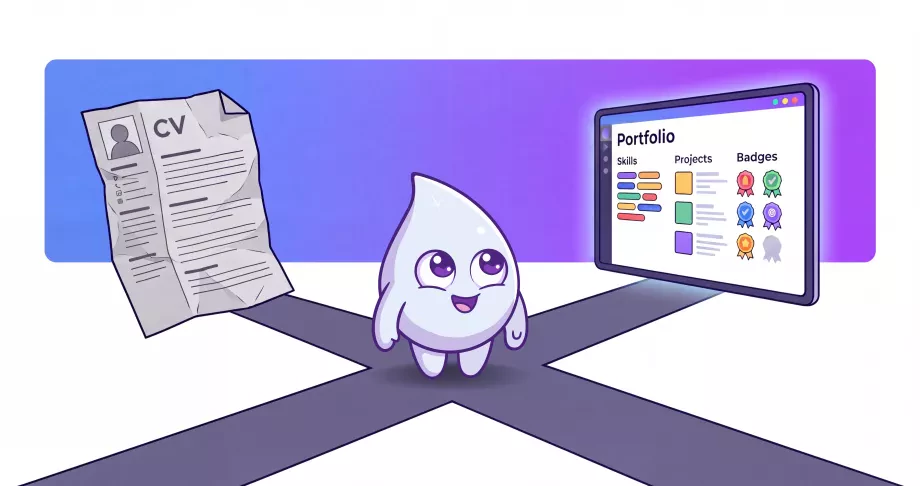
The observation: a CV is no longer enough
The world of work has changed profoundly. The shift towards portfolio careers is accelerating, and is no longer limited to senior professionals. Young workers are increasingly adopting multiple income streams and project-based engagement throughout their careers.
The idea that a person follows a single career path in their lifetime is outdated, a sentiment shared by 82% of senior executives according to the Gi Group Holding survey "The Work Life We Want".
In this context, the traditional CV is showing its limits: rigid, linear, unable to reflect the richness of a complex and evolving career journey.
The question is no longer "What have you done?" but "Can you prove it?"
What is a digital portfolio, really?
A digital portfolio is not an improved CV. It is a living space that goes beyond the professional sphere, it captures everything that shapes you: training, community involvement, personal projects, life experiences.
A space where you:
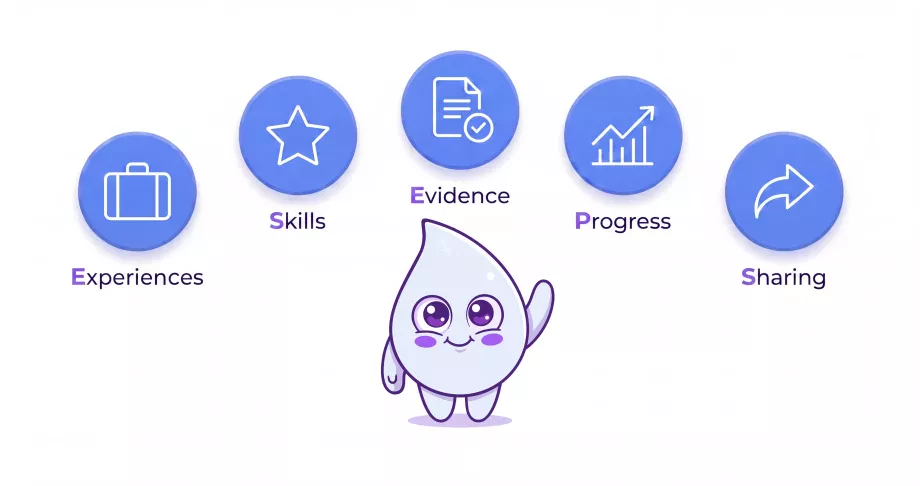
Document your experiences, professional, educational, personal, over time
Connect those experiences to concrete skills, acquired throughout and across the breadth of life
Prove your progression with tangible evidence
Share your journey with employers, trainers or collaborators
The fundamental difference? A CV tells what you have done. A portfolio demonstrates what you know how to do, and who you are becoming.
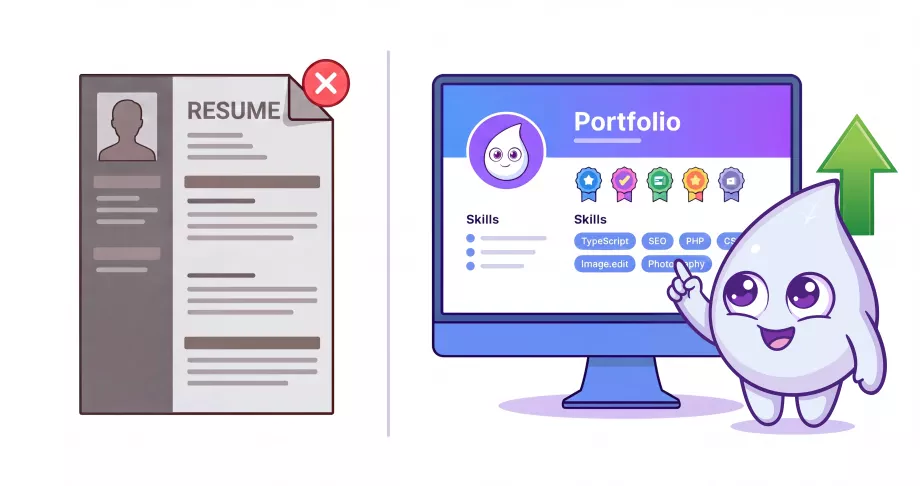
Why it has become indispensable in 2026
1. Career paths have become non-linear
Career changes, mobility, volunteering, continuing education... Today's journeys no longer look like a straight line. They are rich, multiple, and often difficult to summarise on a single A4 page.
A digital portfolio makes it possible to connect the dots of these complex journeys, whether professional or not, and to show their coherence.
2. Skills are acquired everywhere
Skills do not develop only in classrooms or companies. They also emerge through volunteering, personal projects, family responsibilities, and civic engagement.
A digital portfolio is the only tool capable of capturing this invisible richness, the kind that doesn't fit into a diploma, but makes all the difference in practice.
3. Education alone is no longer enough
Initial training lays the foundations. But real skills are built over time, through experience, mistakes, and practice. The digital portfolio bridges this gap between training and the field, between theory and demonstrated practice, and this, throughout life.
What a good digital portfolio must contain
An effective portfolio is not just a list of professional experiences. It must contain:
📌 Structured experiences Context, challenge, actions, results, learnings. Not just "I did that", whether professional, educational or personal.
🎯 Skills linked to frameworks Your skills must be understandable by any recruiter, trainer or assessor.
📊 Tangible evidence Photos, documents, testimonials, measurable results. Show, don't tell.
📈 Visible progression A good portfolio shows your evolution over time, not just a snapshot. It is a living narrative, not a frozen photograph.
🔗 Shareability It must be easy to share, internally and externally, depending on the context.
How to start today
There is no need to wait until your journey is perfect. Start now, with what you have, including experiences that may seem insignificant.
3 simple steps:
1. Choose a recent, meaningful experience Not necessarily a professional one. A training course, a community project, a responsibility taken on, everything counts.
2. Structure it honestly Context → Challenge → Actions → Results → Learnings
3. Identify 2-3 skills mobilised Connect them to your field, or simply to your life.
Then do it again next week.
In three months, you will have a portfolio that truly speaks for you, in all your richness.
Conclusion
The digital portfolio is no longer a competitive advantage. It is a necessity.
In a world where skills are acquired everywhere and at all times, those who document their progression, professional and personal, have a head start over those who do not.
The good news? It is never too late to start. And every lived experience is already a skill in the making.
Want to go further? Discover how the Uscope ecosystem supports you in building your portfolio, throughout and across the breadth of life, at :
Sources used for this article:
Gi Group Holding, The Work Life We Want, 2025
Digital Strategy Institute, US Higher Education in 2026, 2026
Cumberland College, 10 Digital Skills That Can Make Students Instantly Employable in 2026, 2026
Revature, State of IT Skills Survey, January 2025
SHRM, Society for Human Resource Management, 2024
Gallup, 2025